Have Scientists Discovered a New Orca Species?


Orcas (Orcinus orca), also called killer whales, are the largest members of the dolphin family. These apex predators live in all of Earth’s ocean basins. They hunt fish and marine mammals, and they occasionally also prey on sharks. They’re truly the ocean’s top dogs. There are several known orca ecotypes, but a new paper argues two ecotypes are actually two distinct orca species.

Orcas are so widespread across the globe, it’s no surprise that some of them prefer slightly different habitats and prey items and even exhibit slightly different behavior. Perhaps it’s also not a surprise that groups of orcas tend to look a little bit different from each other, too.

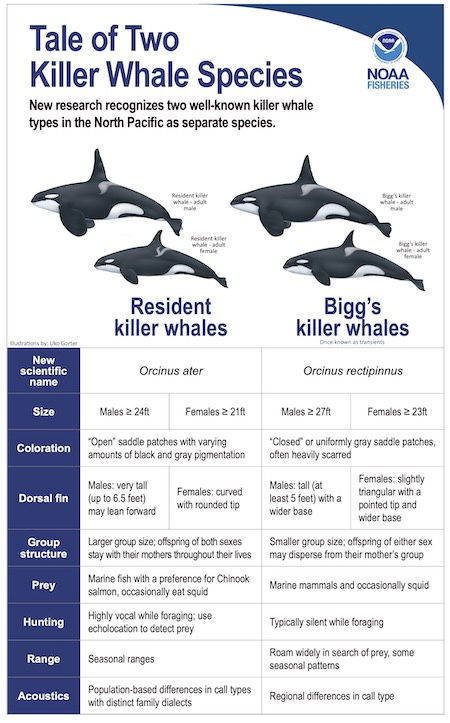
Commonly recognized orca ecotypes in the North Pacific Ocean, for instance, include resident, transient, and offshore orcas. NOAA says each ecotype differs in appearance, diet, habitat, genetics, and behavior.

A clear difference between resident orcas and transient or Bigg’s orcas, for instance, is their preferred prey. Resident orcas eat fish (particularly salmon), while transient orcas prefer marine mammals like seals and sea lions, in addition to squid.

Proposal for New Orca Species Recognition

Now, scientists suggest there’s enough evidence to revise the taxonomy and recognize resident and transient orcas as two distinct orca species. Morin et. al. write in a newly published research paper:

“Our review and new analyses indicate that species-level status is justified in both cases, and we conclude that eastern North Pacific Bigg’s killer whales should be recognized as Orcinus rectipinnus [. . .] and resident killer whales should be recognized as Orcinus ater.”

Images by John Durban and Holly Fearnbach using a non-invasive drone authorized by research permit 19091 issued by the US National Marine Fisheries Service (NMFS) via NOAA

Notable differences between resident and transient/Bigg’s orcas, besides their dietary preferences, also include the shape of their dorsal fins and the shape of the white marking (“saddle patch”) behind their dorsal fin. Behavioral differences include group sizes, hunting/foraging methods, and even how much noise they make.

Interestingly, the two groups of orcas don’t tend to intermix, even though they live in relatively close geographic proximity and have an overlapping range. Even more importantly, the scientists say that the two groups’ DNA suggests they’re genetically distinct enough to warrant being two distinct species or subspecies.
new orca species
Image courtesy of NOAA

So what’s next for this proposal? It’s headed to a committee that will vote on whether the taxonomy needs to be revised. Do you think there are multiple orca species?


Source link


Orcas (Orcinus orca), also called killer whales, are the largest members of the dolphin family. These apex predators live in all of Earth’s ocean basins. They hunt fish and marine mammals, and they occasionally also prey on sharks. They’re truly the ocean’s top dogs. There are several known orca ecotypes, but a new paper argues two ecotypes are actually two distinct orca species.

Orcas are so widespread across the globe, it’s no surprise that some of them prefer slightly different habitats and prey items and even exhibit slightly different behavior. Perhaps it’s also not a surprise that groups of orcas tend to look a little bit different from each other, too.

Commonly recognized orca ecotypes in the North Pacific Ocean, for instance, include resident, transient, and offshore orcas. NOAA says each ecotype differs in appearance, diet, habitat, genetics, and behavior.

A clear difference between resident orcas and transient or Bigg’s orcas, for instance, is their preferred prey. Resident orcas eat fish (particularly salmon), while transient orcas prefer marine mammals like seals and sea lions, in addition to squid.

Proposal for New Orca Species Recognition

Now, scientists suggest there’s enough evidence to revise the taxonomy and recognize resident and transient orcas as two distinct orca species. Morin et. al. write in a newly published research paper:

“Our review and new analyses indicate that species-level status is justified in both cases, and we conclude that eastern North Pacific Bigg’s killer whales should be recognized as Orcinus rectipinnus [. . .] and resident killer whales should be recognized as Orcinus ater.”

Images by John Durban and Holly Fearnbach using a non-invasive drone authorized by research permit 19091 issued by the US National Marine Fisheries Service (NMFS) via NOAA

Notable differences between resident and transient/Bigg’s orcas, besides their dietary preferences, also include the shape of their dorsal fins and the shape of the white marking (“saddle patch”) behind their dorsal fin. Behavioral differences include group sizes, hunting/foraging methods, and even how much noise they make.

Interestingly, the two groups of orcas don’t tend to intermix, even though they live in relatively close geographic proximity and have an overlapping range. Even more importantly, the scientists say that the two groups’ DNA suggests they’re genetically distinct enough to warrant being two distinct species or subspecies.

new orca species
Image courtesy of NOAA

So what’s next for this proposal? It’s headed to a committee that will vote on whether the taxonomy needs to be revised. Do you think there are multiple orca species?


Source link

More from author

Leave A Reply

Please enter your comment!
Please enter your name here

Related posts

Latest posts

Days After Carlson’s Nuclear Strike Warning, Iran Tells Citizens How to Survive a Blast

With fears of a possible nuclear confrontation between the United States and Iran growing, Iranian state media has released something that should get...

Tucker Carlson Says a U.S. Nuclear Strike on Iran Could Be Days Away.

Tucker Carlson is warning that President Trump could authorize a nuclear strike against Iran as early as November 7. The claims come as...

Supermarket Freezers Across Europe Hijacked Overnight, Weeks After Massive Attack in France

Hackers have once again targeted Europe’s food supply, remotely manipulating supermarket refrigeration systems and destroying thousands of dollars worth of food. The latest...

Want to stay up to date with the latest news?

We would love to hear from you! Please fill in your details and we will stay in touch. It's that simple!